
South and Southeast Asia in Global Health Governance: A Regional Perspective

Executive Summary Global health governance (GHG) is undergoing a significant transformation. Over the past three decades, the institutional architecture underpinning global health has shifted from a predominantly intergovernmental model (for example, the World Health Organization [WHO]) to a dense and multi-layered web of actors including multilateral development banks (MDBs), global public–private partnerships (GPPPs), philanthropic organisations, […]
Pandemic Agreement and the New World of Global Health Governance
The WHO Pandemic Agreement (PA), adopted in May 2025, comes at a critical moment in Global Health Governance (GHG). While negotiations to finalise its most contentious provisions, Article 12—the Pathogen Access and Benefit Sharing (PABS) annex—are ongoing, the four-year negotiation process is a foundational moment for GHG. On the one hand, the final agreement has […]
Key Insights | The Pandemic Agreement & its implications for PPPR in South & South-East Asia

This study analyses the implications of the pandemic agreement (PA) and its negotiations for building an equitable PPPR regime, focusing on South and South-East Asia and pathways to strengthen PPPR. The authors analyse the a) changes in the ‘equity’ provisions between the zero and final draft of the PA b) negotiations which produced the final […]
Improving global and regional health governance and cooperation: perspective of South and Southeast Asia

This document serves as a briefing paper, produced by the Centre for Social and Economic Progress (CSEP) and the United Nations University International Institute for Global Health (UNU-IIGH) under the umbrella of The Asian Collective for Health Systems (TACHS). It collates a broad spectrum of data and information, based mostly on a non-systematic desk review […]
Implications of the Pandemic Agreement for South and Southeast Asia

While the Pandemic Agreement marked a historic milestone, its true test lies in whether it can bridge the systemic equity gaps that continue to fragment global health governance. As negotiations for the Pathogen Access and Benefit Sharing (PABS) system head toward the 2026 World Health Assembly, critical questions remain about accountability and reliability of the […]
South and Southeast Asia in Global Health Governance- A Regional Consultation Summary Report

In late November 2025, the Centre for Social and Economic Progress (CSEP) and the United Nations University’s International Institute for Global Health (UNU-IIGH) co-hosted a two-day regional consultation on South and Southeast Asia in global health governance. Experts and practitioners from Sri Lanka, India, Brunei, Indonesia, Thailand, Malaysia, Singapore, and other countries participated in the […]
Shifting power dynamics in global health governance – a challenge and an opportunity for Asia and the Global South
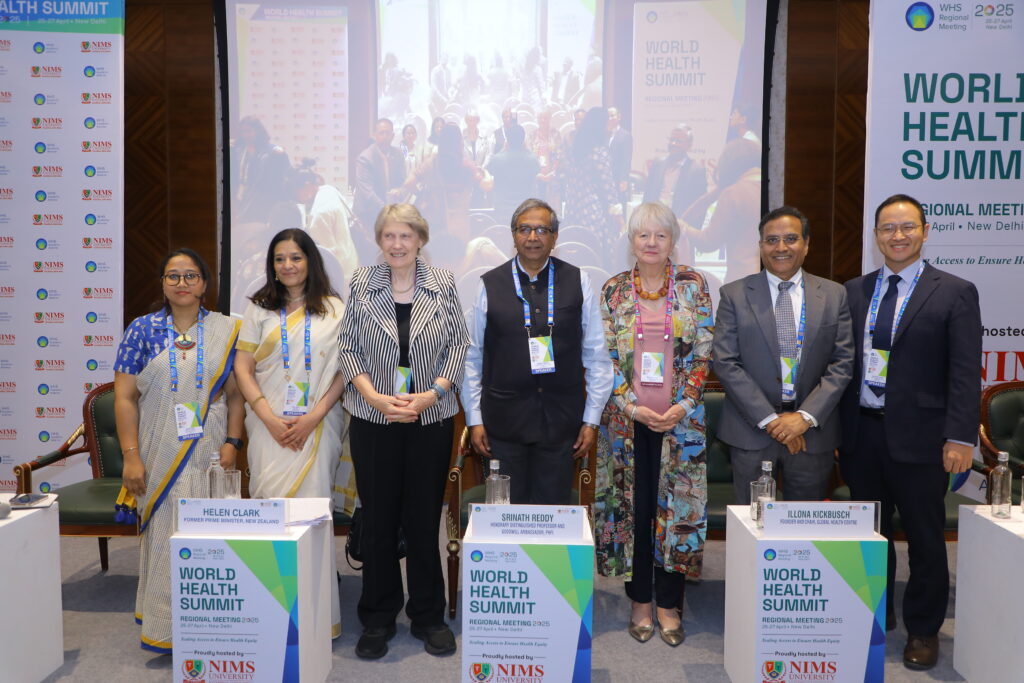
The COVID-19 pandemic and subsequent geopolitical shifts have exposed fundamental weaknesses in global health governance, creating both challenges and opportunities for Asia and the Global South. This commentary, emerging from the Regional World Health Summit in New Delhi (April 2025), examines how countries in South and Southeast Asia are responding to these pressures through enhanced […]
Geopolitics and Health Equity: A Complex Interplay
A pandemic agreement, laying out principles of governance to tackle future health emergencies was recently adopted at the World Health Assembly on May 20, endorsed by 124 countries. The result of three years of negotiation, the agreement aims at strengthening global cooperation in pandemic preparedness and response through equitable distribution of vaccines, diagnostics, and treatments. […]
Health Networks and Platforms in Asia: A Background Analysis for The Asian Collective for Health Systems

As a precursor to the launch of the Collective, a landscaping exercise was carried out to examine the existing networks and platforms in Asia in order to inform the need, objectives and vision of the Asian Collective based on the gaps and areas for further strengthening identified through analysis. The report was titled Health Networks […]